


Continued from December…
By HARVEY WINJE
Marti Maltby’s January ‘26 Peace House Community Column on page 4 is about “community as a form of spirituality.” This Gallery of Loss series of articles is about loss of trust, buildings, residential neighborhoods, and places of memories. All of those are vessels of community and losing them threatens community as spirituality. Thank you Marti for passing on the words and wisdom from Dr. Kelly Sherman-Conroy.
Review of Parts I & II
Gallery of Loss Part I October 2025 was reprinted from April 2010 as an example for others to write a personal loss, too, that has broader meaning.
That article prompted more details and analysis. I asked myself, “So what? Why is this of interest beyond my own nostalgia and some laments?”
The article grew into Parts:
Part I set the scene using a 1951 photo in the side yard of my boyhood home at 2512-14 Chicago Ave. where a brand new specialty hospital would be built north and across 26th Street from Northwestern Hospital 20 years later. It was to be one hospital on a large, new campus on which four existing hospitals would share some buildings centered at 25th Street and Chicago Ave. Part I briefly explained how two risky new concepts enabled the construction of Minneapolis Children’s Health Center, opening December 1972, and to be a part of Minneapolis Medical Center, Inc.-MMCI. Abbott Hospital and Northwestern Hospital merged in 1970 on paper and became one hospital at 27th and Chicago in 1980. The MMCI Campus was pre-empted by other events including national funds and attention to the Vietnam War.
Part II explained how the new pediatric hospital expanded west of Chicago Ave. 30 years later after it had merged with Children’s Hospital of St. Paul; becoming Children’s MN in 1994. Part II explained how betrayal by Children’s MN, PPL and two neighbors led to the demolition of Block 5 that had been mutually agreed to remain residential.
Part III
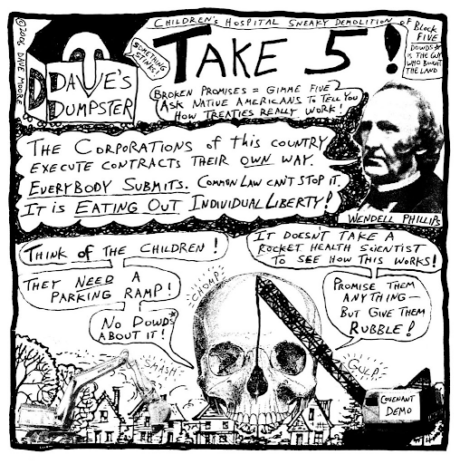
Institutional Leadership: Children’s MN, Media, PPL, Messiah Church, Children’s MN
Dr. Alan Goldbloom, CEO of Children’s MN Hospitals and Clinics from January 2003 to December 2014, told a City Council Committee hearing testimony regarding Olivet Presbyterian Church and Parsonage on the south end of “Block 5” 2006, “Phillips is an unliveable neighborhood!”
Phillips residents were shocked by his absurd insult! Phillips was home. Phillips was liveable; although threatened by institutional expansion for decades that threatened liveability.
Dr. Goldbloom bragged of the exceptional care Children’s gave to children far from Phillips in a manner that guilted anyone objecting to the damage they did to give care. Apparently, he makes choices when to follow the Oath to which doctors pledge their practice.
Media
A WCCO News report of Goldbloom’s retirement in 2014 stated, “Dr. Goldbloom built the specialty center where a blighted neighborhood once stood.”
What blight did they mean? The four city blocks occupied by Children’s MN were not crime ridden, vacant and boarded houses, or suffering from any uninhabitable conditions. They were occupied with all signs of a healthy community along with retail stores and churches.
It is unlikely WCCO was referring to the blight after this was land stolen, Indigenous inhabitants murdered, eradication of culture and language, and kidnapping children from parents that occurred centuries ago by white settlers.
Phillips Community has sustained decades of slanderous reporting such as this by major media sources.
Project for Pride in Living
A PPL Board member told me how nice the PPL office was compared to what it was before,” as she stood greeting people in the living room of where I grew up. At that same Self-Sustainability office Open House event, PPL CEO, Joe Selvaggio, said he was disappointed my mother didn’t attend. I asked if he had invited her. He had not. Years before when my parents still lived in that house, he had used my parents at their kitchen table for a photo-op for People Magazine showing PPL’s neighborliness.
Messiah Church
Years later, the Messiah Lutheran Congregation sold their Sanctuary at the north end of Block 5 for $800,000.00. They also sold the half block of land between Columbus Ave. and Park Avenue and the 1953 Parish Center on the east half of that parcel along with the lease held by Augsburg-Fairview Academy.
Messiah Congregation’s website explains their desire to liquidate properties and use monies for their ministry that were being drained by excessive heating and other costs of the building. Church leaders’ claim the building was structurally failing was not true; verified by qualified professionals. Misinformation was also given by leaders that the building couldn’t be sold if the City had given the building Historic Preservation status. The reference on the Messiah Church website to the Mpls. The Historic Preservation Committee being all white people and wishing to preserve Swedish Heritage by listing the Church as a landmark is disingenuous.
If money for ministry were the only motive for property sale, making the property available for competition on the open market would likely have increased gain. Who was in the room when that decision was made? Were there unadmitted motives with sales to Children’s MN?
Historic Preservation goes far beyond the bricks and mortar of a building. The land on which people live, and place shelters, and places to exchange their work and products, and places to gather are central to lives and memories of lives.
Any church is the vessel to hold elements that speak to all of the senses of people and to shield them temporarily from the elements of weather long enough to acknowledge one another in community while amidst pleasing sounds, words, sights, and aromas; providing a brief moment to honor that which holds them together. It is community within brick and mortar.
Messiah Church was one such place that brought together the artistry of brick masons, carpenters, plumbers, electricians, architects, grain workers, newspaper workers and owners, farmers, store workers and owners, stained glass artisans, theologians, composers, and musicians. It was more than brick and mortar for the “brick and mortar” had absorbed the sense of community that it once held.
Part IV in February will explain how decisions of church congregations are usually highly influenced by their pastoral leadership with a couple anecdotal experiences the Messiah Congregation experienced since 1908.
Part V in March will explain the missed opportunity by Children’s MN; Messiah Church Sanctuary as a Positive Sum Win-Win-Win-Win-Win for all involved instead of a Zero-Sum, one wins and one loses scenario.