




242nd in a Series from Tales of Pioneers and Soldiers Memorial Cemetery…
By SUE HUNTER WEIR
This started out to be a story about Lena Potts, a young African-American woman who died on March 13, 1905, from tuberculosis at age 23. It turned out that there is not a great deal of information to be found about her but the home where she died has an amazing history.
Rev. Matthew W. Withers
What is known about Lena is that she was the daughter of Charles and Martha Withers and was most likely born in Tennessee around 1882. If her story remains somewhat elusive, the same is not true of her brother, the Reverend Matthew W. Withers, who was pastor of Bethesda Baptist Church from 1900-1906. Lena lived with him and his family in the church’s parsonage at 2408 17th Avenue South, a house in Phillips that is still standing. But the parsonage was much more than that.
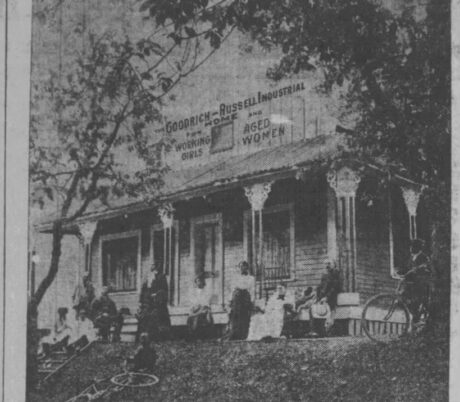
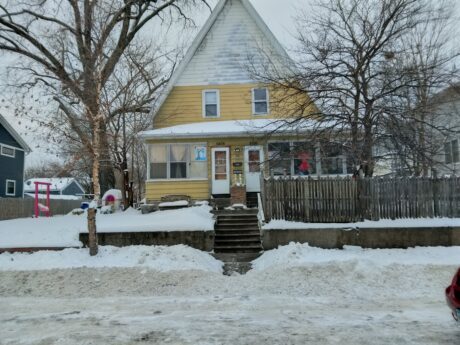
Goodrich-Russell Industrial Home for Working Girls
In the spring of 1903, Pastor Withers founded the Goodrich-Russell Industrial Home for Working Girls at that address. The home was named after Cora Goodrich and E. Augusta Russell, two of its benefactors.
The purpose of the home was to provide training as domestics for young women from the South who wished to move North. At the time wages for domestics in Southern states were reported to be $1.25 a week compared with $4.00 a week in Minneapolis, and domestics were in high demand here. Prospective employers paid transportation costs with the understanding that they would be repaid once the women began working for them. Newspapers printed testimonials from satisfied employers, and the Minneapolis Journal proclaimed the program a “great success.”
The house was described as a “… pleasant and substantial building.” It had an industrial-sized oven with a capacity for baking 65 loaves of bread at a time. Residents were trained in a number of domestic skills including cooking and sewing. The home prided itself on its instruction in “fine washing,” which would “rival that of [a] famous French laundress.” A music teacher moved here from St. Louis, Missouri, to offer piano lessons to those who wanted them.
The Goodrich-Russell Home provided other services in addition to its training program. In 1905, they provided housing for 75 women, helped 105 women find jobs as domestics, provided free meals to 200 people and free nights’ lodging to 90 guests. On Thursdays and Sundays, people gathered at the home for “music, singing, and a jolly good time.”
In 1905 the Home was given a new name. It became the Goodrich-Russell Industrial Home for Working Girls and Home for Aged Colored People. One of the elders who lived there was a widow named Sarah Gordon. Mrs. Gordon was about 50 years old when she arrived in Minnesota in 1879, which made her an early (though not the earliest) member of Minneapolis’ African-American community. She had been born in Indiana, in 1829. Her father was born in North Carolina which suggests that he was likely enslaved at some point in this life, and her mother was born in Pennsylvania, a free state. Mrs. Gordon worked as a private nurse in several households until the late 1890s. When the 1900 Federal Census was taken, she reported having given birth to five children, only one of whom was still living. The burial locations of her children and her husband, James, are unknown. Mrs. Gordon died at the age of 76 from acute bronchitis on May 29, 1905, two and a half-months after Lena Potts died.
In 1906, Reverend Withers had a falling out with some members of Bethesda’s congregation. The source of their conflict is not clear, but he believed that the decision to end his tenure had been made by a small number of disgruntled parishioners. He pointed out that during his tenure church membership had increased from 57 to 172. Their mortgage had been paid off and he had raised money to renovate the church’s basement. Nonetheless, he decided to leave once he received the backpay that was owed him.
The Goodrich-Russell Home came to an end when Pastor Withers left. Plans to open a commercial bakery and to provide training for young men from the South never happened. Reverend Withers went on to found Zion Baptist Church in North Minneapolis and later did mission work in North and South Dakota.
If you are interested in meeting other local history lovers to learn how to research your house or to share what you know, please contact me for details at shunterweir@gmail.com. Our interests are not limited to houses—there are any number of interesting and exciting topics about the four Neighborhoods of Phillips Community to be explored.
SUE HUNTER WEIR is Chair of Friends of the Cemetery, an organization dedicated to preserving and maintaining Minneapolis Pioneers and Soldiers Memorial Cemetery. She has lived in Phillips for almost 50 years and loves living in such a historic community.