




239th in the series Tales from Pioneers and Soldiers Memorial Cemetery
By ALEX WESTON
Fleeting glimpses of a vanished world
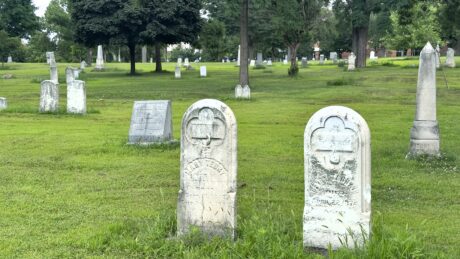
Over 22,000 people are buried in Minneapolis’ Pioneer & Soldiers Memorial Cemetery, but there are only 1,820 grave markers.
The privileged are more likely to have
their stories preserved.
This works as a metaphor for history itself. History is not “what happened in the past,” but rather a web of stories we tell about the past. Like the grave markers at Pioneer & Soldiers Memorial Cemetery—which represent only around 8% of the individuals buried there—the evidence from which we construct these stories is fragmentary. We get only fleeting glimpses of a vanished world.
Some stories get passed on, while most are forgotten. Generally, the privileged are more likely to have their stories preserved, while the marginalized tend to be forgotten. The Cemetery has so few headstones partly because it was a burial ground for common people, not the rich and powerful. But even here there are disparities. Some paupers’ graves were never marked. Others once had cheap wooden markers that rotted away. Some were carefully maintained or replaced by subsequent generations, but most markers did not have this privilege and were left to the ravages of weather, pollution, and vandalism.
Fortunately, stories are continually being recovered, thanks to historians such as Sue Hunter-Weir. For over two decades, Sue has resurrected tales of the residents of Pioneer & Soldiers Cemetery and printed in the alley.
I first met Sue when she gave a talk at the Hennepin History Museum, where I work. I was deeply impressed by her commitment to unearthing stories of exactly the kind of people who usually get erased from the historical narrative.
Life stories had to be triangulated
Of course, we cannot tell any stories without information. This is another place Sue Hunter-Weir demonstrates her genius. Often starting with only a burial record, she has combed through countless archival sources to produce over 230 vivid biographical sketches. This is especially impressive considering that most of her subjects never left any account of their own. Their life stories had to be triangulated from surrounding evidence.
Bit by bit, the unique contours of an individual life emerge.
Sue is a master of this process.
I sometimes think about Pompeii, an Ancient City buried by a volcano. There, archaeologists discovered empty pockets of air in the ashy soil that, when filled with plaster, revealed human forms. Though any mortal remains were long gone, the shape of the surrounding material preserved haunting portraits of individuals from nearly 2,000 years ago. When researching everyday or marginalized individuals, we often face an analogous problem: a human-shaped hole at the center of the story we are trying to tell. Sometimes all we can do is research as much as we can about the surrounding context. Bit by bit, the unique contours of an individual life emerge. Sue is a master of this process.
When I was asked to give a Cemetery tour for the Hennepin History Museum, Sue’s articles became my primary source of information. I worried about relying so much on another’s work. After all, Sue gives her own Tours, and they’re fantastic (you should take one). I did not want to merely copy her.
Lives of people together reveal a bigger picture
I eventually realized what I could contribute: further context. After 20 years working in local history museums, I have a broad general knowledge of Minnesota History. I discovered that the stories of individuals Sue uncovered can take on even more depth when viewed as part of a much larger tapestry. This process goes both ways. The lives of the people buried in the Cemetery, when taken together, reveal a bigger picture: that of a City growing from frontier settlement to thriving metropolis.
“Every life is a unique story worth telling.”
Cemeteries provide one outlet for the universal human need to commemorate the dead. For me personally, the study of history plays a similar role. I also believe there are many pragmatic reasons to study history (for example. to better understand our world, to learn from past mistakes etc.) but underneath this I am motivated by a conviction that every life is a unique story worth telling. We will sadly never be able to tell everyone’s story, or to tell them completely, in much the same way that the 1,820 remaining grave markers only represent a fraction of those buried. But that does not make the pursuit of history any less worthwhile.
Telling a person’s story says, “This life mattered.”
To tell a person’s story is to say: “This life mattered.” I am honored to be able to tell at least a few stories of this Cemetery’s residents.
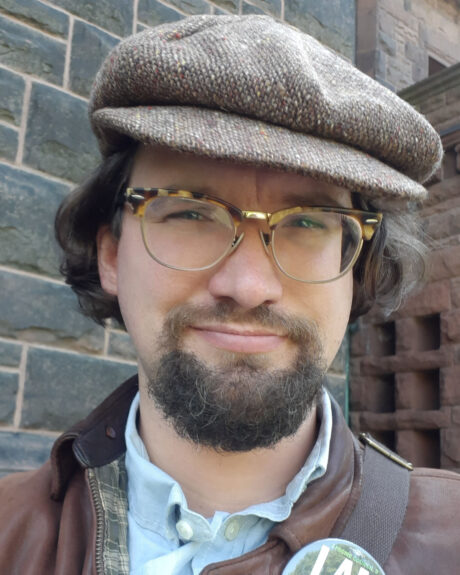
ALEX WESTON is Manager of Guest Services and Administration at the Hennepin History Museum, which currently features an exhibit about Pioneers & Soldiers Memorial Cemetery. He will be leading a tour of the Cemetery on Oct. 5th. Details can be found at: https://www.hennepinhistory.org