




from the series Tales from Pioneers and Soldiers Memorial Cemetery…
243rd in a Series
By SUE HUNTER WEIR
Jane and Ebenezer Hodsdon were among the early New Englanders who settled in what was to become Minneapolis. They moved here with their three young children from Maine in 1852, and a few years later purchased 100 acres of land at what is now the intersection of Bloomington Avenue and Lake Street. Their nearest neighbors were Martin and Elizabeth Layman, the original owners of the Cemetery.
Beatrice Morosco, the Hodsdon’s granddaughter, wrote a family history, The Restless Ones, that was published in 1965. It is a charming and lively, though not always accurate, account of the family’s early days in Minneapolis.
In 1855, a few years after the Hodsdons arrived, they were joined by Jane’s parents, George and Joan Robbins Wardwell. Martin Layman hired George to survey his land and offered him two burial plots in the Cemetery as payment. Only three years later, one of those graves was put to use.
Joan Wardwell was, as Morosco described her, “unsuited for the rigors of frontier life.” She complained endlessly about the harsh weather and compared Minneapolis unfavorably to the life that she had left in Maine. In 1857, she fell ill, complaining of abdominal pain. Doctors examined her and determined that she had cancer. She died in 1858. Hers was the first recorded death in Minneapolis attributed to cancer. Morosco claimed that her grandmother was the second person to be buried in the Cemetery, but that is not true; there were at least 30 other burials before hers.
The family prospered over the next decade, mostly due to Jane’s hard work. Ebenezer, a Universalist minister, was appointed chaplain for the Minnesota State Legislature and spent most of his time socializing with the city’s elite while Jane ran the farm and cared for their eight children.
There is a dark side to the family story that Morosco neglected to tell. She portrayed Ebenezer as an eccentric, selfish man, but he was far worse than that. She wrote that Ebenezer “decided to leave for Stillwater where there was always a demand for skilled workers in the sawmill.” But Ebenezer did not go to Stillwater voluntarily, and certainly not to work in a sawmill. In 1863, Jane filed a complaint accusing her husband of having sex with their 15-year-old daughter. Her case was dismissed on the grounds that one spouse could not testify against the other without that person’s consent. The case did not go away, however, and in 1864, Ebenezer was tried and convicted of incest. He was sentenced to serve two years in Stillwater prison.
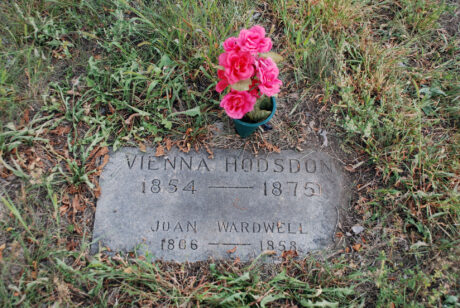
On December 4, 1875, another of their daughters, Vienna (“Vi”) Hodsdon, died from “galloping consumption,” one of many names used for tuberculosis. By all accounts, Vi was a beautiful young woman with “exceptionally lovely auburn hair.” She worked as a model in a hair salon located near what is now known as Loring Park.
Morosco described a heartbreaking scene between Vi and her younger sister Cass. Every night, Cass read the latest installment of a serialized story from the local paper to her bedridden sister. One night, Cass told Vi that she was too tired to read to her but promised to read it first thing in the morning. Vi died during the night.
The family’s house was too small to accommodate the number of mourners, and the funeral was held in the local schoolhouse. Since she died during the winter, there were no fresh flowers. Her casket was placed in the Cemetery’s vault, and it wasn’t until five months later that she was buried next to her grandmother in the second of the two graves that her grandfather had received from Martin Layman.
The family’s troubles continued. In 1887, Jane filed for divorce, which the press called the “sensational and filthy Hodsdon divorce case.” There were charges of adultery and sexual and physical abuse. In the end, Jane lost her case. Judge Rea, among other things, claimed: “No woman…would ever be a witness to such a crime as she testified to, the debauching of her own daughter by her husband, and afterward bear him a child.” This despite the fact that Jane’s story was corroborated by a daughter and granddaughter, and the fact that she had filed a complaint, which was dismissed by the court, as early as 1863.
There is much more to their story, but that’s for another time, perhaps. Joan Wardwell and Vienna Hodson are buried in Lot 101, Block B. Ebenezer and Jane Hodsdon are buried at Lakewood, though not next to each other.