





249th from Tales from Pioneers and Soldiers Cemetery…
By SUE HUNTER WEIR
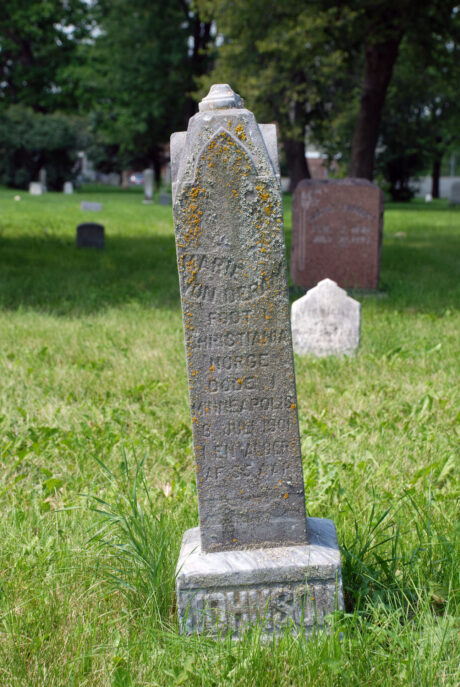
born in Christiana (now Oslo) Norway in 1871. She died from
heatstroke on July 17, 1901. She was 30 years old. Anna
Johnson was buried in the same lot in 1911. Their relationship is
uncertain. PHOTO: Tim McCall
It’s only August and this already feels like a too-long summer. Prolonged temperatures in the nineties. Records being broken. Although the scope and scale are bigger, this isn’t a recent phenomenon. Recorded deaths in Minneapolis due to heat and sunstroke date back to the 1860s and there were undoubtedly many more that went unrecorded before that. The Cemetery’s recorded death due to heatstroke was that of an “unknown German man” on July 16, 1866. Nothing else was known about him.
While conventional wisdom claims that it is the very young and the elderly who are most susceptible to the effects of heat, this was not the case for the twenty-one people whose cause of death was recorded as “sunstroke” or “heatstroke.” Only two of them were in their sixties. Eight were in their forties, and another five were in their thirties. There were only three women. There may have been many more heat-related deaths—drownings, heart-related deaths, etc.—where high temperatures were a contributing, though not primary, cause of death.
What most of the 21 fatalities had in common was that they were working-class: teamsters, day laborers, factory and railroad workers. They worked outdoors in blinding heat, in stifling factories or underground in sewers. Only two of the men worked in what might be called “indoor” jobs. Alfred Sandberg (d. June 28, 1913) was a bartender. John Holman (d. July 1, 1911) worked in a grocery store.
The majority (17 of 21) were immigrants: Norwegians, Swedes, Danes, Slovaks, and Germans. Two were born in Minnesota, and the birthplace of two others is unknown.
The papers had little to say about the deaths of the three women. The Tribune described Anna Peterson (d. July 19, 1868) as a “Swede woman whose name we did not learn.” Fortunately, someone did know her. The paper also failed to mention that Anna’s two-month-old daughter, Annie Sophia Peterson, died on the same day as her mother. Cemetery records do not list the cause of the baby’s death, but it seems likely that she, too, died from the heat. They are buried together in the Cemetery’s paupers’ section. Marie Martinsen’s (d. July 27, 1892), death merited only a single sentence and even then The Tribune got her name wrong (A. Mortenson). Marie VonDeram (d. July 17, 1901) was a professional nurse. Although the papers had little to say about her, judging from her marker, someone very much cared about her.
Several men collapsed on the street and died without regaining consciousness. Since most people did not carry any form of identification, the coroner often had to wait for family or friends to come looking for their loved ones. Long lines of visitors passed through the morgue hoping, yet dreading, to find someone they knew.
The Tribune reported that “nothing whatsoever” was known about a man who collapsed while walking down Washington Avenue on August 20, 1906. He was later identified as Peter Larson, a day laborer, who left behind a wife and seven children.
John Danielson (d. July 16, 1904) was initially listed as an unidentified man. The coroner posted a description of a “heavy-set, middle-aged, laboring man…[with] a dark mustache, and dark hair.” An autopsy revealed that his heart and lungs were in poor shape and that “he had been drinking heavily lately.” On the day that he died, the temperature reached 103 degrees. His was not the only alcohol and heat-related death. Christopher Romfog’s (d. July 23, 1893) autopsy revealed that he “came to his death through sunstroke and alcoholism.” He was only 28 years old.
The newspapers were full of ads and home remedies that were guaranteed to prevent heatstroke. In 1913, the Duffy Malt Whiskey Company claimed that sunstroke was caused by drinking ice water, and recommended, not surprisingly, that people should drink whiskey instead. An enterprising laundry company assured readers that stress caused sunstroke and that one way to reduce stress was to pay them to do your laundry. Perhaps the strangest suggestion for how to reduce heatstroke came from a physician at St. Barnabas Hospital in 1887. He claimed that men who wrapped their heads in cloth or who wore hats (“derbies”) could ward off heatstroke by placing cabbage leaves under their headgear.
People had few ways to escape the heat. A few businesses closed early. When temperatures reached into the nineties, tens of thousands of people packed streetcars and headed for the water, bathing in city lakes during the day and sleeping in parks at night. Home air conditioning didn’t appear until the late 1920s and then only for the privileged few. Then, as now, heat-related deaths were a problem for the poor. The good old days were not good for everyone.
SUE HUNTER WEIR is Chair of Friends of the Cemetery, an organization dedicated to preserving and maintaining Minneapolis Pioneers and Soldiers Memorial Cemetery. She has lived in Phillips for almost 50 years and loves living in such a historic community.