
News & Views of Phillips Since 1976
Saturday October 17th 2026





Phillips Oral History Project: Oct. ’26
This month, Janis Lodermeier returns to talk about hitchhiking.
A lot of people hitchhiked. Like hippier types, but then it started to get really spooky, not just in this neighborhood, just anywhere. It never was safe. I should not have been doing it. But I didn’t have a lot of choices. And sometimes you meet up with somebody that was hitchhiking and it could be fun. Until it wasn’t. And there were times I even told some people that I hitchhiked, that gave me rides, I said ‘you should be careful too of who you pick up because they’re crazy crazy people too.’
Some of the rides were fun and…most of them were not memorable. I wouldn’t remember and then they, it was just getting to the point where there were, it was bad most the time. [Even] my brothers told me ‘you shouldn’t be doing this anymore.’ And stuff, but I would not recommend it. Times were different. You’d have to be plum crazy to do it now, for real. Even then it was just a brief period where it was all it was fairly safe, but then it but I would never say, recommend doing that. I rarely got picked up by a woman, even hippie women, but I don’t blame them.… Read the rest “Phillips Oral History Project: Oct. ’26”
Spotlight on Our Small Neighbors
By MARY ELLEN KALUZA
Minnesota’s State Butterfly
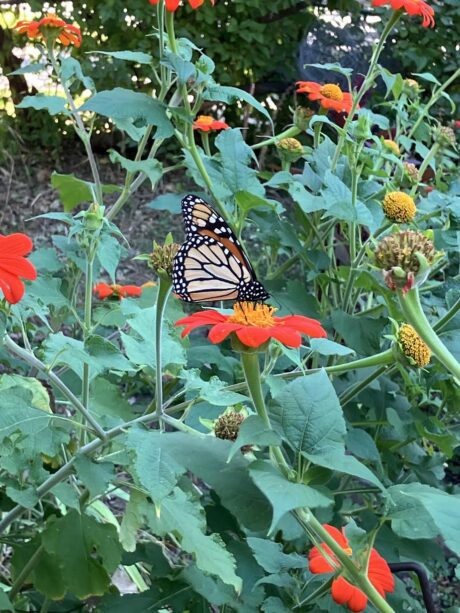
Autumn. We love the colors, mourn the waning daylight, and turn on the furnace. But we rarely give a thought to the small critters (i.e. insects) preparing for the upcoming cold, despite the royal status some might have. Some insects dig or build shelter to keep warm for the winter. Others, such as the monarch butterflies, migrate to avoid the cold winter.
Monarchs are common immigrants to Minnesota, arriving mid May to early June. Entice them to your garden with tithonia (aka mexican sunflower), zinnias, asters, and other yummy looking flowers. Milkweed is particularly appreciated as monarchs lay their eggs on milkweed leaves exclusively and the emerging caterpillars feast on the leaves.
Monarchs in our area east of the Rocky Mountains travel to Mexico for the winter, a trip of well over 2000 miles to the mountains in central Mexico. They need to eat and drink on the way. That’s why clearing farm land of native vegetation like milkweed, or introducing insecticides that poison their food supply, greatly reduces their populations.
It is not terribly warm high in the mountains of central Mexico so butterflies stay close to each other in the trees for warmth, stirring only as the sun gets higher in the sky to refuel on local flowers.… Read the rest “Spotlight on Our Small Neighbors”


Keep citizen journalism alive!

War on Humanity
from the series Something I Said…
By DWIGHT HOBBES
Correlations between Donald Trump’s presidency and his hero Adolf Hitler’s regime continue. Dachau and other early concentration camps included abandoned factories, breweries and warehouses. These are places you stock and store materials – things, not human beings. ICE had such plans for migrant detainees. Until community unrest and state lawmakers put a halt to them. A vacant commercial building on Emery Way in Shakopee was going to hold up to 1,500 people. The local developer, Opus, decided not to finalize a lease. In Woodbury a half-million- square-foot facility off I-94 was in the works but has not panned out. The Department of Homeland Security had, in fact, reportedly targeted several industrial properties for Trump’s mass deportation goal, but hell raising locals scuttled those sites as well.
Yet again, Minnesota’s resolve is not in the Third Reich playbook. On all fronts, from
guerilla networking to protesting in the street to politicians standing their ground and pushing
back through the courts, resistance is strong on several fronts.
Shutting down those projected facilities came on the heels of White House Border Czar
Tom Homan cleaning up after discarded Secretary of Homeland Security Kristi Noem.… Read the rest “War on Humanity”